

Tactile Sensors
For Robotics & AR/VR Applications
Image: Loomia 131 Point tactile sensor for Festo’s Robotic Hand 
Custom Tactile Sensors & Pressure Sensors
-
A tactile sensor is a device that measures specific properties of an object through physical contact between the sensor and the object.
It functions like a system mimicking the human sense of touch, gathering information about characteristics such as temperature, shape, weight, texture, and pressure.
Modern tactile sensing technology is widely used in areas such as health monitoring, robotics, augmented and virtual reality (AR/VR), and wearable devices.
-
For AR/VR and robotics, the Loomia Electronic Layer can be used for end effector tactile sensor.
We collaborate with each company to customize our tactile sensors (FSRs) for their unique needs.
Loomia’s LEL can be designed into matrixes for pressure mapping on an end effector or robotic surface.
Loomia’s LEL can be designed in unique geometries for fingertip sensing and to wrap around finger and knuckle shapes for hand-shaped end effectors.
-
Our technology can be used to map surfaces on fingertips and hands for data collection.
Our tactile sensors are fully customizable and can be tuned for low-force touch for hand gripping and touch applications.
The LEL can laminate to knit and stretch materials to gather touch and force data from gloves and hands. Our team can work with you to place tactile sensors in the locations where data is most needed for your team.
-
-Robotics: The tactile pressure sensor can be used to add a sense of touch to end effectors or as a data input source for training robots off of human movements. Loomia tactical sensors can allow a robot to handle lightweight and delicate items such as apples, textiles, and more.
-AR/VR: Tactile sensors embedded in fingertips and palms enable precise input detection, enhancing interactive experiences by providing real-time feedback for more immersive and responsive virtual environments.


Example: End-Effector Sensing
The Loomia Electronic Layer (LEL) was used by Festo to create a 131-point tactile sensor array for a robotic hand end effector. The resulting sensor allowed the Festo robot to handle lightweight and delicate items such as apples, textiles, and more. Turn on the video audio to learn why Festo chose Loomia for their Engineering Challenges. Contact us to explore more about robotic tactile sensors!
Tactile Sensors for your Application
-
Step 1. Evaluation
Assess our tactile sensor technology with a sample.

-
Step 2. Loomia Lab
We’ll make your custom tactile sensor design in the Loomia Lab.

-
Step 3. Production
Produce your tactile sensor at up to 20,000 units a week.

Loomia Tactile Sensor Benefits
Customizable: For custom pressure mapping, our tactile sensors are engineered and precisely manufactured to meet your project's unique specifications. Loomia tactile sensors can sense from a gentle touch to body weight.
Scalable: Can scale up to 20,000 units per week in an ISO 9001 facility
Conformable and Flexible: The Loomia Electronic Layer is ultra-flexible, making it the perfect solution for high-motion-area pressure sensing and tactile pressure sensors.
Unique Performance: Loomia’s patents cover a unique mesh and sheet material-based sensor that can give different performance than printed solutions.
Masking Available: Loomia can mask out sensing in high-bend areas like the knuckles.
Sensor size can range from 1" x 2" up to 20" x 24".
Sensitivity down to .8N
Check out other LOOMIA pressure sensors!

Check out LOOMIA’s Hub and Projects on Hackster
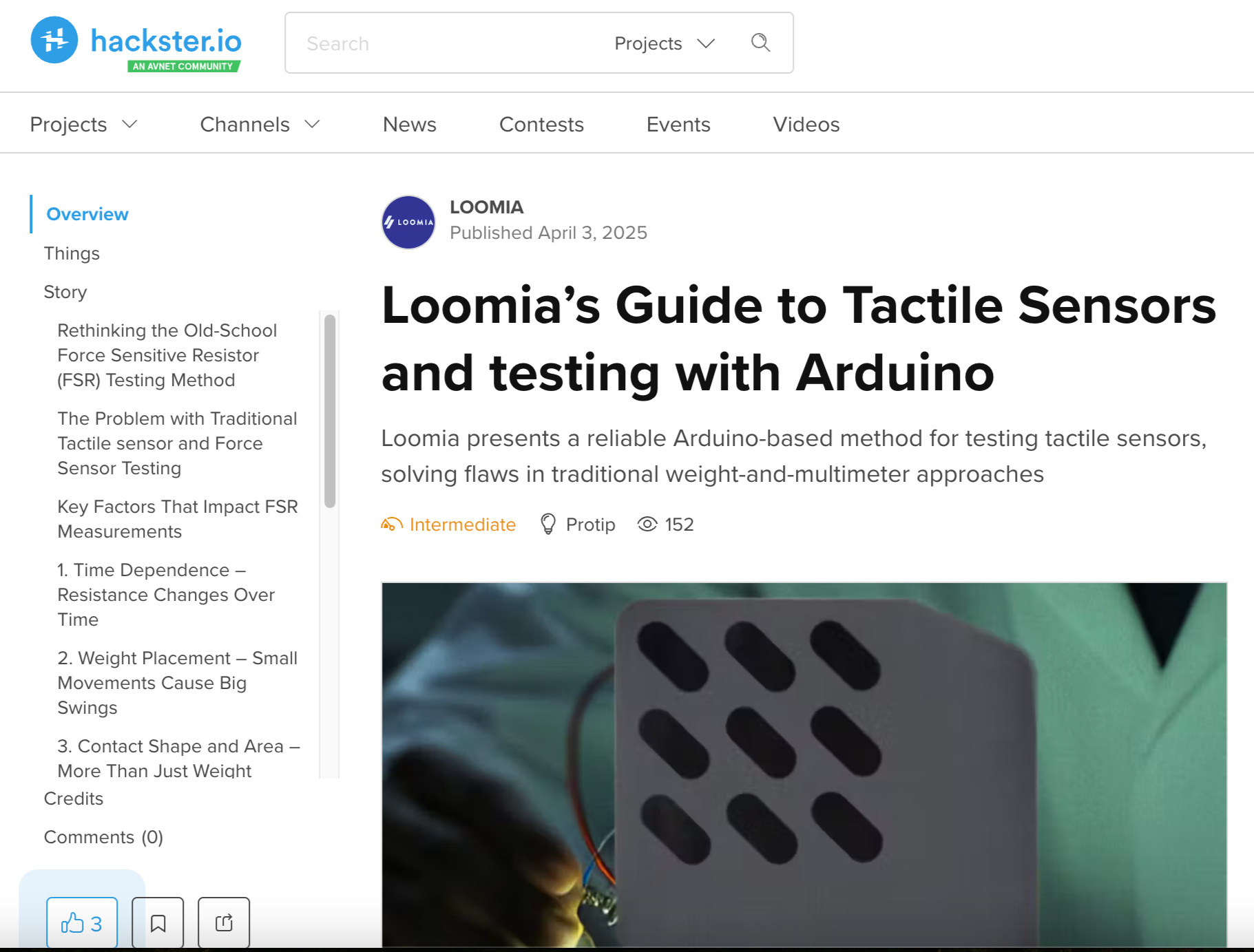
Our projects on Hackster are another useful tool for learning more about tactile sensing or pressure sensors for robotics. In this example project, we cover topics like:
Limitations of traditional testing methods, such as dead weight testing
Effects of time, contact area, and material stiffness on sensor readings
Improving testing consistency using Arduino automation
Challenges with ADC readings and mapping them to accurate resistance values
Meet the Loomia Tactile Sensor Glove | Real-Time Pressure Mapping for Robotic Hands!
In this video, we see Loomia's tactile sensing glove in action, capturing real-time pressure data from the index finger as the user performs tasks.
FAQ
-
A tactile sensor is a device that measures specific properties of an object through physical contact. It mimics the human sense of touch, detecting characteristics such as temperature, shape, weight, texture, and pressure. Loomia’s tactile sensors are used in robotics, AR/VR, and wearable technology to enhance interaction and data collection.
-
Loomia’s tactile sensors are used in various industries, including:
-Robotics: Enabling end effectors to handle delicate objects and training robots using human movements.
-AR/VR: Collecting input data from fingertips and palms to enhance interactive experiences.
-Wearables: Mapping surfaces on hands and gloves for accurate data collection and force measurement -
Yes! Loomia works with companies to develop custom tactile sensors based on their specific requirements. We offer unique geometries, different pressure sensitivities, and tailored placement to optimize data collection.
-
Loomia’s sensors stand out because they are:
-Ultra-flexible and conformable, ideal for high-motion areas.
-Manufactured with patented mesh and sheet-based technology, providing superior performance compared to printed solutions.
-Available with masking options, ensuring accurate sensing by eliminating interference in high-bend areas like knuckles. -
Yes! Loomia’s tactile sensors can be laminated onto knit and stretch materials, making it ideal for wearables like gloves. The sensors are designed to seamlessly integrate into flexible surfaces while maintaining durability and accuracy
-
Yes! Loomia offers masking options to prevent sensing in high-bend areas, such as knuckles. This ensures precise data collection without distortion from movement.